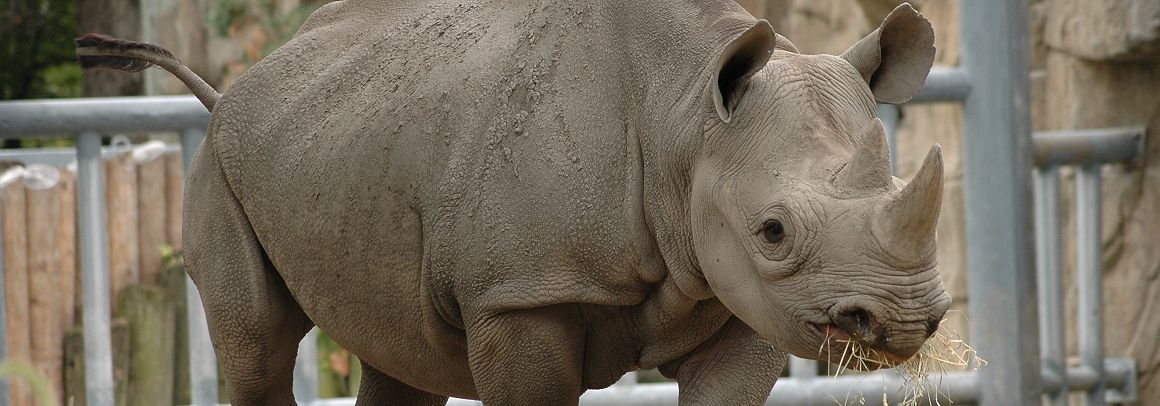
Black Rhinoceros (Diceros bicornis), Lincoln park Zoo (U.S.A.) - © Rolf Veenhuizen
We would like to share information from conservation projects as widely as possible. This part of our website will be updated regularly with other projects.
Macaca Nigra Project
Project Macaca Nigra combines different projects with research, education and conservation objectives, focused on Celebes Crested Macaques, Macaca nigra. Founded in 2006 and based in the Tangkoko Reserve on Sulawesi Island. Its main objective is through Tangokoko Conservation Education, the organization’s education program, to increase the positive behavior of local populations towards their environment, using the Celebes Crested Macaques as a flagship species.


Associação Mico-Leão-Dourado
In order to prevent the extinction of the species, experts agree that at least 2,000 golden lion tamarins, Leontopithecus rosalia, are living in Brazil in 25,000 hectares of connected and effectively protected forests are needed. Based on this observation, the tamarin lion project has been working for years to protect Brazilian forests and to reintroduce primates from captivity.
In 2013, the Brazilian association for the protection of golden lion tamarins carried out a census of the species. The results estimate a population of 3,210 tamarins, which is potentially enough to say that the population is viable! In addition, the largest patch of connected forests seems to represent 27,042 hectares. Currently, only 9,948 hectares are effectively protected. The objectives are obviously to protect other forests and to connect them through reforestation and awareness programs with local communities.


The AQUAC3 Project
AQUAC3 is a digital platform designed to improve the welfare of fish and aquatic invertebrates in aquariums and zoos.
It responds to a major gap: most marine species observed in these institutions are still wild caught, yet relatively little research and shared guidance exist on their welfare under human care.
This project aims to centralize reliable information on husbandry, biology, and welfare, while connecting aquarium managers, and aquarists with researchers. Through a moderated forum, a specialised education database, and optional consultancy support, the project would help teams share experience, collaborate, develop practical welfare indicators, and adopt evidence-informed best practices.
Ultimately, AQUAC3 seeks to turn scattered knowledge into coordinated action—supporting sustainably and on a long-term basis, both animal wellbeing and the professionals responsible for their care.
Please help to improve the welfare of fish and aquatic invertebrates in aquariums and zoos to fill in a short questionaire:
EN – Aquarium/Zoo Managers (13 questions):https://forms.gle/PAt9k6HmdJdQmK118
EN – Aquarists (8 questions): https://forms.gle/CnPWRfpL2c5wULN66
ES – Responsables de acuario/zoo (13 preguntas): https://forms.gle/dCmayNkjtC7Z6Nx66
ES – Acuaristas (8 preguntas): https://forms.gle/NwAeEXi4v2gD7PwRA
FR – Responsables d’Aquarium/Zoo (13 questions): https://forms.gle/fZfUj54xS8xf7RLf6
FR – Aquariologistes (8 questions): https://forms.gle/mJMupSMiYpudb7fK6


Chimfunshi Wildlife Orphanage Trust
Founded in 1983, Chimfunshi Wildlife Orphanage Trust (CWOT) is one of the world’s oldest and largest chimpanzee sanctuaries. Located along Zambia’s Kafue River, it covers more than 10,000 hectares of miombo woodland, wetlands, and riverine ecosystems.
CWOT provides a safe home for over 150 rescued chimpanzees living in large semi–free-range enclosures that support natural behaviour and social structures. A dedicated team of experienced keepers and managers, supported by an on-site veterinarian, ensures lifelong welfare for chimpanzees, many of whom have suffered past trauma. Their work is strengthened by a fully equipped wildlife clinic providing rapid and high-quality medical care. CWOT also rescues and cares for other wildlife species like African grey parrots, turacos, and antelopes, to name a few, mainly saved from illegal trade or injury.
Beyond animal care, CWOT promotes community development, education, organic farming, research, and conservation.


